Invisible Security: 365nm invisible Fluorescent Pigment
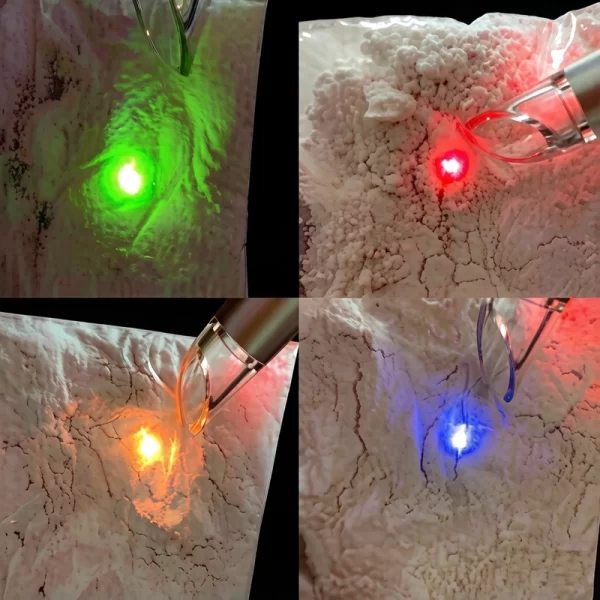
365nm Invisible Fluorescent Pigment (also known as “Long-Wave” or “Blacklight” pigment) is a high-performance functional additive used primarily for covert authentication and industrial tracing. Unlike standard neon pigments that are visible in daylight, these specialized particles remain completely transparent or white in ambient light, revealing their vibrant colors only when targeted by a ultraviolet light source,especialy by 365nm UV light.
How It Works: The “Hidden” Glow
- The invisible fluorescent pigment utilizes a photophysical process called fluorescence. When the “invisible” molecules are struck by 365nm UV photons, they absorb the energy and instantly re-emit it at a longer, visible wavelength.
- Total Concealment: In its “ground state,” the blacklight reactive powder has no absorption in the visible spectrum (400–700nm), making it undetectable on white paper, plastique, or fabric.
- Instant Verification: The transition from invisible to Vibrant colors happens in nanoseconds and is fully reversible. Once the UV source is removed, the mark disappears immediately.
- Long-Wave Specificity: It is specifically tuned for UV-A (365nm), which is the most common and safest UV wavelength used in handheld scanners and industrial LED lamps.
Key Technical Features
- Superior Stability: Available in both Inorganic (Metal Oxide) and Organic versions. Inorganic grades offer extreme heat resistance (up to 600°C+) and “Blue Wool” lightfastness ratings of 7–8, ensuring the mark stays functional for years.
- Non-Migratory: The insoluble nature of the pigment prevents it from “bleeding” or migrating through layers of plastic or paper, which is critical for high-resolution security printing.
- Particle Precision: Typically engineered with a sub-micron or low-micron particle size (D90: ≈ 5μm), allowing for seamless integration into offset, flexographic, and inkjet inks without clogging equipment.
- Broad Compatibility: Can be directly incorporated into resins (PE, PP, PLA, ABS, PVC), oil-based varnishes, water-based coatings, and specialized security lacquers.
| Sector | Usage Scenario | Purpose |
| Security Printing | Banknotes, tax stamps, and passports. | High-level covert authentication and anti-counterfeiting. |
| Brand Protection | Luxury goods and pharmaceutical labels. | Discrete “Track & Trace” to prevent product diversion and gray-market sales. |
| Industrial Tracing | Automotive and HVAC fluid systems. | Invisible leak detection; identifying exact exit points in complex machinery. |
| Forensic Marking | “Theft-tracking” powders. | Transfers to skin/clothing upon contact to prove a “chain of custody.” |
| Logistics | Invisible barcodes and QR codes. | Automated sorting and inventory management without altering packaging aesthetics. |

365nm UV invisible Fluorescent Pigment for security, identification, applications de codage et de lutte contre la contrefaçon.
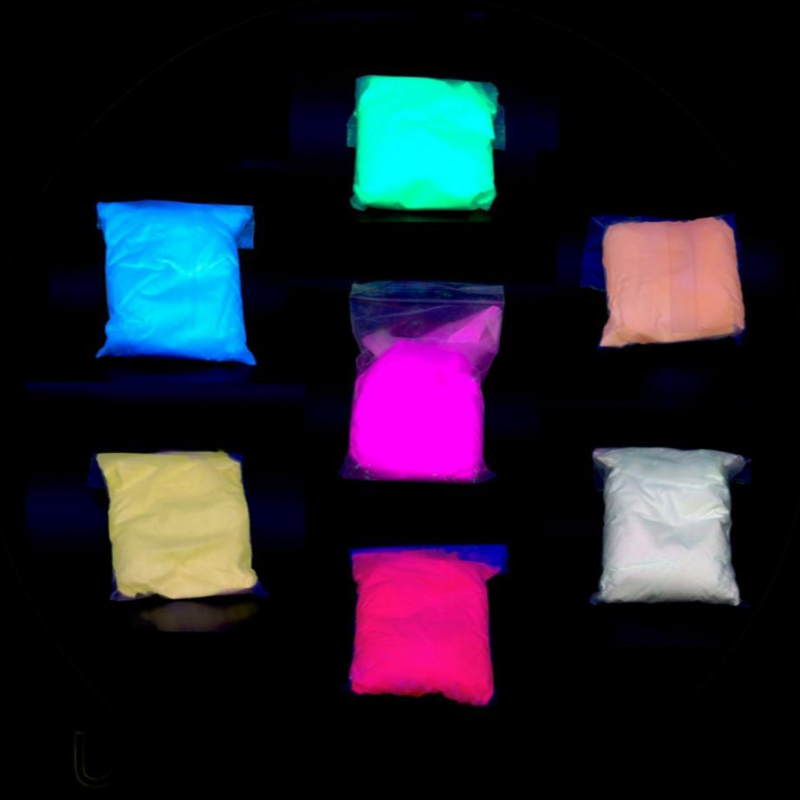
Ces pigments jour de couleur, avec un blanc d’aspect poudre blanc cassé, et sont pas perceptible lorsque incorporés dans les encres de sécurité, fibres et papiers. Lorsque irradiés avec lumière UV (lumière noire), ces pigments émet une lumière fluorescente jaune, vert, rouge, bleu,blanc,violet,couleurs orange et sont immédiatement identifiable. Certaines applications courantes sont en timbres-poste, billets de banque, cartes de crédit, billets de loterie, Laissez-passer de sécurité, etc..
Applications: Il peut être ajouté à différents médiums comme la peinture, encre d’imprimerie, matières plastiques, en caoutchouc, verre et l’eau à base de véhicules de toutes sortes. Ces poudres spéciales sont largement utilisés dans la lutte contre la contrefaçon, protection contre le vol, décoration, sécurité des documents, publicités et à peu près n’importe où que vous avez besoin d’un pigment fluorescent invisible de haute qualité. Il est largement utilisé dans la sécurité ou d’autres produits haut de gamme.
Index de la technologie:
1: Aucune impureté mécanique visible n’est autorisée à l’intérieur de la poudre.
2: Densité:d≤3.4±0.02g/cm³
3: Diamètre des particules médian:D50≤5.0±0.5μm
4: Relative luminosity≥99 %
5: Longueur d’onde pic principal du spectre électroluminescent: 505nm.
6: Point de fusion: Se dissocie 1250 C.
7: Solubilité dans l’eau: insoluble dans.
8: Gravité spécifique: 3.2-3.6